


Key Takeaways
- A whole-house filter treats water as it enters the home, while reverse osmosis (RO) uses a semipermeable membrane to reduce a broad range of dissolved contaminants.
- Whole house water filter vs reverse osmosis is not simply a choice between “basic” and “advanced” filtration. The right option depends on your water quality and treatment goals.
- Carbon filtration is commonly used for taste, odor, chlorine, and certain organic contaminants, while RO can reduce dissolved solids and a wider range of contaminants.
- A residential reverse osmosis drinking water system is often installed at the point of use, such as a kitchen tap, rather than treating every gallon used throughout the home.
- A whole house reverse osmosis system can provide broader treatment but is a more complex installation and may have higher operating and water-use considerations.
- Testing your water first can help determine whether you need filtration, RO, softening, or a combination of treatments.
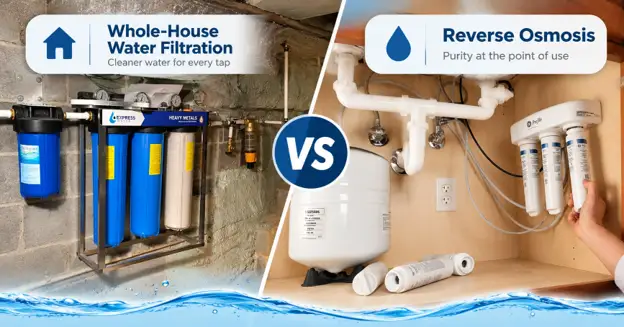
When homeowners compare reverse osmosis vs filtration, the biggest difference is what each system is designed to accomplish. A whole-house filter is generally installed at the point where water enters the property, so treated water flows to multiple fixtures. Reverse osmosis is a membrane-based treatment process that can remove many dissolved substances from water.
That distinction matters. You may not need the same level of treatment for drinking water, showers, laundry, and outdoor use.
Start With the Water, Not the Equipment
Before choosing a treatment system, identify what is actually present in the water. A system designed to improve taste and odor is solving a different problem from one intended to reduce dissolved minerals or specific contaminants.
The CDC notes that whole-home filters treat water entering the home, while point-of-use systems are designed to treat water at a particular fixture. It also recommends checking certification information to understand what a filter is designed to remove. CDC guide to choosing home water filters.
This differentiates reverse osmosis vs water filter on the basis of function rather than mere quality comparison between the two.
What a Whole-House Filter Actually Does
Whole house filters, also called point-of-entry systems, treat water before it passes through house plumbing. The type of treatment depends on the type of filtration technology in use, as the filter may deal with sediment, chlorine, some organic substances, or others.
A common type of filters found in water filtration systems is the carbon filter. It only improves the taste and odors in water but may also lessen the impact of some chemicals in water supply.
That is why reverse osmosis vs carbon filter comparisons need to focus on the specific contaminant rather than assuming one technology is universally preferable.
There is another practical consideration: a whole-house filter affects water used for bathing and cleaning as well as drinking and cooking. If your primary concern is the water you consume, treating the entire household supply may not always be necessary.
Where Reverse Osmosis Fits In
Reverse osmosis pushes water under pressure through a semipermeable membrane. The membrane separates treated water from a concentrated reject stream, allowing RO systems to reduce many dissolved solids and contaminants.
A residential reverse osmosis drinking water system is commonly installed as a point-of-use system. In that configuration, the system supplies treated water where you drink or cook rather than processing the water used for every household activity.
This is an important distinction. A standard under-sink RO system and a whole house reverse osmosis system are not interchangeable simply because both use RO technology.
Whole House Water Filter vs Reverse Osmosis: The Practical Difference
Think of the two approaches in terms of coverage and treatment intensity.
A whole-house filter is designed around where water is treated: at the entry point to the home. RO is defined primarily by how water is treated: through a semipermeable membrane under pressure.
That means you can have:
- Whole-house carbon filtration
- Point-of-use reverse osmosis
- Whole-house RO
- A combination of whole-house pretreatment and point-of-use RO
Sometimes it is better to employ more than one technology in a home. One such example would be pretreatment which may be used to protect other equipment while reverse osmosis will allow additional treatment of drinking water.
What About Well Water?
Homeowners using private wells should analyze filtration systems carefully. Well water may have different chemistry due to its geographical origin and therefore all the treatment must be chosen based on the tests.
Whole house reverse osmosis for well water can be considered when testing identifies contaminants that RO is designed to reduce. However, RO may require pretreatment depending on incoming water quality, and the system must be properly sized and maintained.
A whole-house system also treats water that does not need to meet drinking-water treatment standards for every use. That can make a point-of-use system a more practical choice in some homes.
Don’t Confuse a Water Softener With RO
The water softener vs reverse osmosis comparison is another case where the technologies solve different problems.
A water softener is primarily used to address hardness, typically by reducing calcium and magnesium through ion exchange. RO uses a membrane process and can reduce dissolved salts and other contaminants.
So a softener isn’t necessarily an alternative to RO. In some setups, the two may serve different stages of the home’s water treatment strategy.
Is a Whole-House RO System Worth It?
A whole house reverse osmosis system cost can be considerably higher than a basic whole-house filter or point-of-use RO system because treating the entire household supply requires equipment capable of handling much greater flow.
There are other factors to consider, too. RO systems produce a reject-water stream, require filter and membrane maintenance, and may need pretreatment. EPA notes that RO can require significant water input and that pretreatment may be necessary to prevent membrane fouling or plugging.
For many households, the question isn’t whether whole-house RO is technically possible. It is whether treating the entire water supply provides enough benefit to justify the installation, maintenance, and water-use requirements.
Choosing Between Filtration and RO
A useful decision process is:
Test → Identify contaminants → Define where treatment is needed → Match the technology → Check maintenance requirements
If your primary concern is sediment, chlorine, taste, or odor, a suitable whole-house filter may address the problem. If testing identifies dissolved contaminants that RO is designed to reduce, a residential reverse osmosis drinking water system may be worth considering for drinking and cooking water.
For homeowners unsure which approach fits their water supply, Water of Texas provides water treatment services based on water quality and household needs, and the type of system being considered. Starting with the water itself rather than choosing equipment first can help avoid paying for treatment that does not address the actual problem.
And if several water-quality issues exist, combining technologies may be more appropriate than expecting one system to do everything.
FAQs:
Q. Do I need reverse osmosis if I have a whole house filter?
Ans: Not exactly. A whole-house water filter and reverse osmosis system may be employed to resolve the different water quality issues. If the filter already employed is sufficient to handle the contaminants that worry you, the reverse osmosis system may be superfluous; to figure out if there is a need for further treatment, one may use water testing.
Q. What is the difference between reverse osmosis and a whole house water filter?
Ans: While a whole-house filtering system treats water when it is delivered, the reverse osmosis system operates differently in that it uses a semi-permeable membrane to filter out the dissolved solids. Hence, when comparing a whole-house filtering system vs reverse osmosis, the difference is partly in terms of the coverage offered and partly in terms of treatment technology.
Q. Is reverse osmosis better than filtered water?
Ans: Neither is automatically better. Reverse osmosis vs filtration depends on the contaminants present, the desired treatment level, and where treated water is needed. RO can reduce a broader range of dissolved substances, while different filters are designed for different contaminants.
Q. Is whole house reverse osmosis worth it?
Ans: It can make sense when there is a specific reason to treat the home’s entire water supply and the system is properly designed for the incoming water. However, a point-of-use RO system may be more practical when the primary goal is highly treated drinking and cooking water.
Q. How much does a whole house reverse osmosis system cost?
Ans: The price of any one whole house reverse osmosis system cannot be determined easily as different factors are involved like water chemistry, the capacity of the system, the need for pretreatment, installation requirements, storage, and maintenance. A water test and professional assessment will provide a more accurate estimate than just the standard expected price ranges.